
A study by Gavin Finley MD
- endtimepilgrim.org
Download the PDF file here.
(Then save it to your tablet).
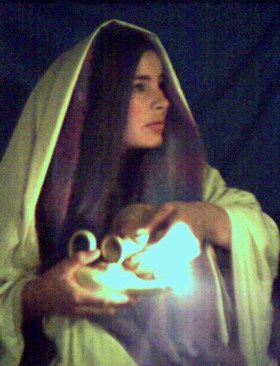
Photo by the author, posed by his daughter Rosemary. If you would like to use the photo for your web page or for ministry purposes you are quite welcome to do so.
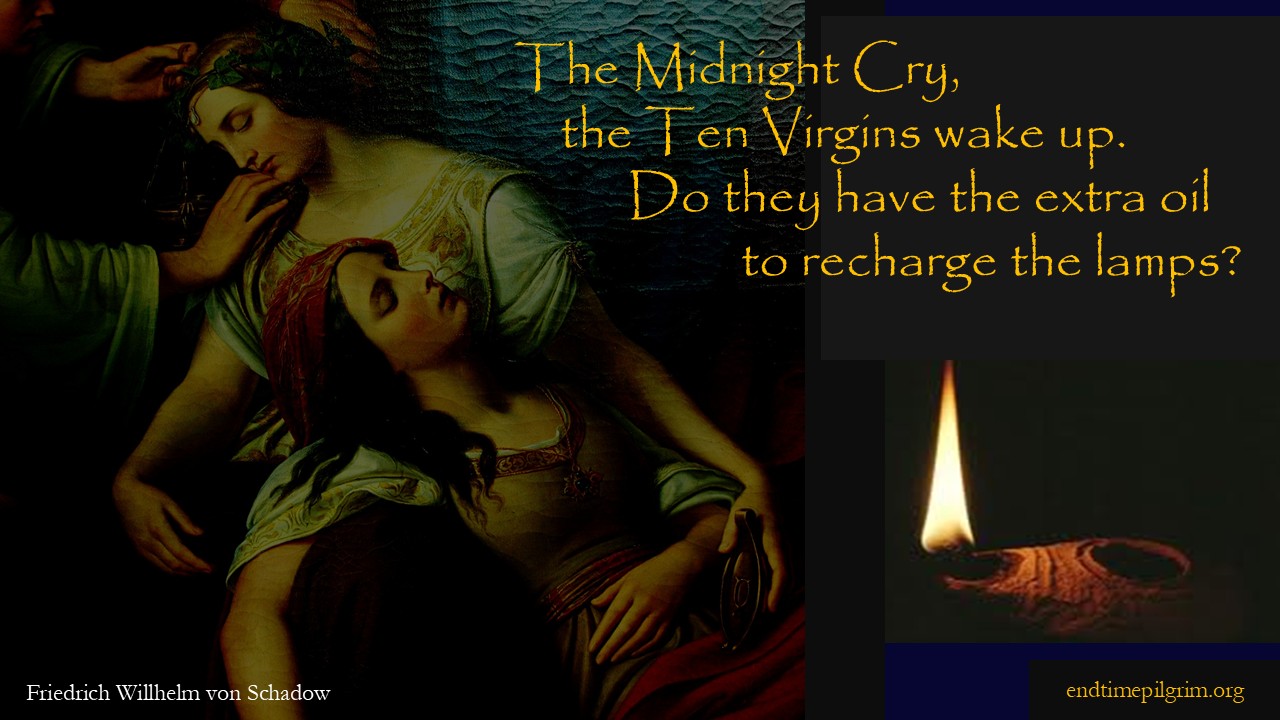
Matthew 25
1 "Then the kingdom of heaven shall be likened to ten virgins
who took their lamps and went out to meet the bridegroom.
2 Now five of them were wise, and five were foolish.
3 Those who were foolish took their lamps and took no oil with them,
4 but the wise took oil in their vessels with their lamps.
5 But while the bridegroom was delayed, they all slumbered and slept.
6 And at midnight a cry was heard:
'Behold, the bridegroom is coming; go out to meet him!'
7 Then all those virgins arose and trimmed their lamps.
8 And the foolish said to the wise,
'Give us some of your oil, for our lamps are going out.'
9 But the wise answered, saying,
'No, lest there should not be enough for us and you;
but go rather to those who sell, and buy for yourselves.'
10 And while they went to buy, the bridegroom came,
And those who were ready went in with him to the wedding;
and the door was shut.
11 Afterward the other virgins came also, saying,
'Lord, Lord, open to us!'
12 But he answered and said,
'Assuredly, I say to you, I do not know you.'
13 Watch therefore,
for you know neither the day nor the hour in which the Son of Man is coming.
The Parable of the Ten Virgins.
The parable of the ten virgins in Matthew 25 is one of the most enigmatic and intriguing in all of scripture. It seems to be a story of great drama and romance. In it we also see a warning, and some information for the saints of great prophetic significance, It is also a wooing, and a calling into a devotion in God. The Spirit of God is speaking to us in the storyline. We find ourselves being drawn beyond our comfort zone. Deep calls out unto deep ...... - Ps.42:7
The facts of the story are straightforward. Five of the virgins were wise and five were foolish. Just who are these 5 wise and 5 foolish virgins? If they are all believers then why the division? Are there two different groups of people within the beloved Congregation of God? And if so, what is it that distinguishes them from each other?
The Symbol of the Lamp in Scripture.
As we look deeper into the story and survey the poetic imagery we observe that all of the ten virgins carried lamps.
The lamp is often pictured in scripture and in our literature as a symbol of the spirit of a person.
PROVERBS 20:27 NKJV
The spirit of a man is the lamp of the Lord,
Searching all the inner depths of his heart."
PROVERBS 20:27 KJV
"The spirit of a man is the candle of the Lord,
Searching all the inward parts of the belly."
("Inward parts of the belly" relates to our deepest feelings.
It is a reference to the origin of our true thoughts and motivations.)
So the lamp, or candle, of the Lord is the spirit of man.
There is a flame present and visible to others, - if he is alive and awake.
The spirit of man at any given time is showcasing a spiritual presence.
That spiritual presence varies from person to person and from time to time.
The spirit being expressed in a person may be of God,
Or we may have accepted "strange fire" from the enemy of our souls.
There is a 'mystery of iniquity' operating in the midst of great deception. (2Thes.2:7)
And there is a 'mystery of godliness'. (1Tim.3:16)
Our ultimate and eternal happiness is not something that comes from
human determination or human striving.
We were designed and created to function in union and in harmony with God.
And the candle of our spirit was originally designed to be lit and fueled by the Holy Spirit.
As children in Sunday School we learned the song,
"Jesus bids us shine with a pure clear light,
Like a little candle, burning in the night.
In this world of darkness, so we must shine.
You in your small corner, and I in mine."
So the lamp, or candle, is the spirit of man.
The Westminster Catechism asks this question.
What is the chief end or purpose of man?
The answer is, "to know God and to enjoy Him forever."
Man was created to live and walk in God. He was created and saved not just for a mansion in heaven but to showcase the works and fruits of His Holy Spirit here on earth. The indwelling Holy Spirit of YHVH-God manifests the Christian graces. They are, in fact, the fruit of the Holy Spirit.
Our Apostle Paul lays them out for us in Gal.5:22-23. These aspects of Godly character are evidence of the indwelling Christ. And they are increasingly evident in a human being as he grows in God.
The nine fruits of the Holy Spirit are,
love, joy, peace,
patience, kindness, goodness,
faithfulness, gentleness and self-control.
The Question of the Oil.
Discussions of the parable of the ten virgins
usually addresses the question of the oil.
What does the oil represent?
In scripture the meaning of the oil is not a difficult matter to elucidate. A quick word study through the Bible will suffice. The oil quite quite typically represents the anointing of the Holy Spirit. The scriptures tell of the oil of gladness and the oil of anointing of God's Presence. The Old Testament scriptures showcase the oil of anointing for priests and kings. Throughout the Bible we also see the oil for the lamps which brings the Light of God's illumination. Poetically the Word and Light of God is there as "a lamp unto our feet" to help guide us along the pathway when the hours of darkness come.
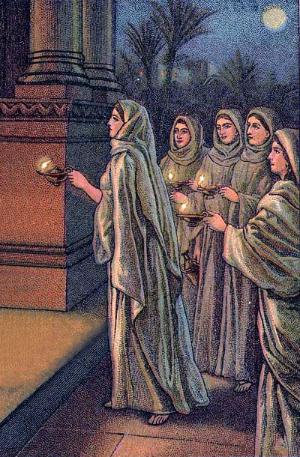
If the oil is a picture of the Holy Spirit then what does that extra jar of oil represent? As we see in the parable, an extra cruse of oil was carried by each of the five wise virgins. Apparently this extra oil supply was the essential difference between the five wise and five foolish virgins. As the party began in the early hours of the evening the difference between the wise and the foolish virgins was not noticeable. All of them slumbered. All of them were approaching burnout as the night wore on. But as the midnight hour came the presence or absence of that extra oil became a critical issue. The wise virgins carried an extra supply beyond and outside of the oil they had in their lamps. They traveled with this extra supply of oil. That extra oil was with them on their person. When the wise virgins ran out of oil or approached "burnout" they could pause and recharge their lamp. They had this extra resource outside themselves but upon their person. The foolish virgins did not.
This matter of the extra oil is exceedingly important. Here we see a reserve supply of oil that went along with the wise virgins as a matter of course. This extra resource was quite separate from the oil that was in their lamps. The oil the wise carried in their lamps was no greater in supply than the oil in the lamps of the foolish. All ten of them saw their lamps beginning to burn out as the midnight hour approached. So this extra oil supply was not a superabundance overflowing from within the lamps of the wise. The wise virgins certainly had extra oil with them. But that extra was not in their lamps. The extra oil came from another companion vessel that they carried with them.
This is a very important point. In the symbolism we see that the extra oil was not to be found within the spirit being of the wise virgins. Their glory and their esteem was not in themselves. The extra oil of Light and gladness came from an external source. It was a supply and a Providence that was outside and beyond their own souls. It was a personal resource to be sure. And it was a resource they obviously had access to. But this extra energy supply was separate from the oil they had within the lamp of their own spirit. This was the critical difference between those who were wise and those who were foolish. What is God trying to tell us here?
Surely the extra cruse of oil is a picture of our Paraclete. The Comforter/Strengthener, our Eternal Supply. He is always with us on our pilgrimage, ...... even the fullness of the Holy Spirit. He is our Strengthener, our Illumination, and our Guide. This is not of ourselves. This is the gift of God.